SonicWall Gen 8 upgrade in India: move now or wait
Decide when to upgrade to SonicWall Gen 8 and Cloud Secure Edge, what it costs, and how to roll it out without downtime in an Indian SMB.
BlogBy ITCG Team
If you have older SonicWall firewalls in your racks, here is the short answer: a SonicWall Gen 8 upgrade in India is now a planning priority, not a someday task. SonicWall's Gen 6 hardware reached end of support on 1 August 2026, and the company has launched its Gen 8 firewalls together with Cloud Secure Edge.
Most businesses still on legacy appliances should schedule the move. This guide is for IT managers and owners of Indian small and mid-size companies.
It answers if and when to upgrade, what Gen 8 and Cloud Secure Edge add, what they cost, and how to roll them out safely.
Why this upgrade question matters now
The decision is straightforward for anyone still on Gen 6. SonicWall's Gen 6 firewalls, including the TZ400, TZ600, NSA 3600 and NSa 3650, reached End of Support on 1 August 2026, which means no further technical support, firmware updates or hardware replacements for these models. Once a device is out of support, the risk compounds month by month.
Gen 6 end of support on 1 August 2026
After the end-of-support date, any new vulnerabilities discovered remain unpatched, which exposes businesses to permanent security risks. There is no path back to a supported state on that hardware.
What unsupported firewalls expose you to
End of support also means threat feeds, intrusion prevention updates and anti-malware signatures stop updating, leaving networks exposed to new and emerging threats. If you are weighing options, it also helps to read the signs your firewall is no longer enough.
What SonicWall Gen 8 actually adds
Gen 8 is a full generation refresh, not a minor update. SonicWall Gen 8 firewalls include nine new models, from the ultra-compact TZ280 to the high-performance NSa 5800, each built for a specific use case such as distributed sites, hybrid teams and mid-sized enterprises.
Models from TZ280 to NSa 5800
Every Gen 8 model ships with cloud-native management, built-in Zero Trust Network Access and an embedded cyber warranty. Under the hood, SonicOS 8 uses patented Reassembly-Free Deep Packet Inspection and Real-Time Deep Memory Inspection for advanced threat protection. Management runs through SonicWall Unified Management, a single console for firewalls, policies, access and accounts.
Security suites EPSS, APSS and MPSS
Gen 8 security suites come in three tiers (SonicWall):
- Essential Protection Security Suite (EPSS) for core protection.
- Advanced Protection Security Suite (APSS) for broader threat coverage.
- Managed Protection Security Suite (MPSS), which adds co-managed services by SonicWall's SonicSentry team for 24x7 monitoring, firmware updates, configuration management and after-hours support.
Embedded cyber warranty
Gen 8 includes an industry-first embedded cyber warranty. Coverage ranges up to $200,000 for MPSS, with up to $1M for optional cyber insurance.
What Cloud Secure Edge does
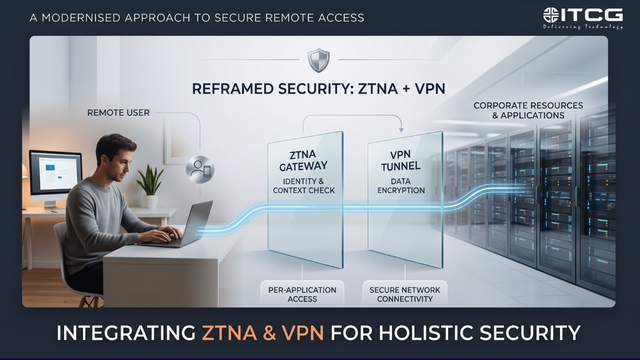
Cloud Secure Edge is the remote-access half of the story. It enables application-level access for remote and hybrid users without traditional VPN complexity, supporting Zero Trust network access.
App-level access without VPN complexity
Traditional VPNs put a user on the whole network. Cloud Secure Edge supports secure connectivity options for remote access and SASE deployments, with simplified licensing for hardware-only, secure connectivity and security suites. That means a user reaches the specific application they need, not the full LAN.
Zero Trust for hybrid teams
This suits distributed Indian teams with staff across branch offices and work-from-home setups. If you want the background on how these models fit together, see how VPN and ZTNA work together. Cloud Secure Edge complements the firewall rather than replacing it, so most businesses run both.
Gen 7 vs Gen 8 and what it costs
The move from Gen 7 to Gen 8 brings higher capacity and throughput with simpler operations. The clearest way to see the difference is to compare the entry-level units head to head.
TZ670 vs TZ680 specs
Looking at the TZ670 against the TZ680:
- The Gen 7 TZ670 supports up to 1.5 million connections (SPI) and 2.1 Gbps VPN throughput.
- The Gen 8 TZ680 supports up to 1.6 million connections (SPI) and 2.5 Gbps VPN throughput.
- The TZ680 also delivers 5 Gbps firewall throughput, 2.5 Gbps threat prevention and 3 Gbps IPS throughput.
Pricing bands for TZ and NSa
Budget in bands rather than single figures. Pricing for SonicWall Gen 8 in India runs roughly as follows, before licensing and promotions:
- TZ Series for SMBs: about $400 to $3,000.
- Mid-range NSa Series: about $3,000 to $10,000.
- Upper models: $20,000 and above.
Final cost depends on the security suite and current offers, so a tailored quote is the only reliable number. Treat the appliance and the recurring licence as separate lines in your budget.
Choosing a security suite
Suite choice drives both protection and price:
- APSS includes Capture ATP, Gateway Antivirus, Anti-Spyware, Intrusion Prevention, App Control, Content Filtering, Anti-Spam, NSM Essential and 24x7 support.
- MPSS adds 24x7 monitoring, policy tuning, configuration, firmware updates and monthly health reports.
If you are still shortlisting vendors, you can also compare SonicWall, Sophos and Fortinet before you commit.
What CERT-In and MeitY expect
In India the upgrade is also a compliance exercise. CERT-In operates under Section 70B of the IT Act, 2000, and its directions apply to all entities operating in India.
Mandatory firewall and log retention
Under the CERT-In Directions 2022, network security controls including firewall deployment are mandatory, alongside incident reporting, log retention and synchronisation with NTP servers. Log management and SIEM integration are mandatory, with a 5-year log retention requirement under CERT-In. Firewall deployment is listed as mandatory across CERT-In, DPDP, RBI, SEBI, IRDAI, DoT and Government or MeitY frameworks.
VAPT and 6-hour incident reporting
Vulnerability assessment and penetration testing are mandatory, so firewalls and network controls must be tested regularly. Incident response is also mandatory, with a 6-hour reporting window for cybersecurity incidents. An unsupported firewall that no longer receives updates makes these controls harder to meet.
If mapping your firewall and logging to CERT-In and MeitY controls feels daunting, ITCG's Cyber Security and VAPT teams configure and validate SonicWall deployments against these mandates. Get a free consultation.
How to roll out Gen 8 without downtime
A clean rollout is mostly planning. The threat picture in India makes the case for doing it properly: the India Cyber Threat Report 2025 analysed 8.44 million endpoints and recorded 369.01 million malware detections, with over 1 million ransomware attacks in the year. We often see the same avoidable issues when teams hurry.
Size for growth, not today
Pick the appliance for where the business will be in three years, not where it is now. Plan for more users, more site-to-site tunnels and heavier encrypted traffic. Account for Indian realities too: variable bandwidth across branch offices and power interruptions that make dual WAN and clean failover worth specifying.
- Check your current peak throughput and connection counts before choosing a model.
- Plan for Wi-Fi 6 access points and SD-WAN links if you run multiple sites.
- Confirm the security suite you need, since APSS and MPSS change the licence cost.
Rollout order and config migration
Gen 8 supports zero-touch deployment and centralised management via SonicWall NSM, which reduces manual errors. A safe order of work looks like this:
- Audit the existing ruleset and remove stale policies before you migrate.
- Stage and configure the Gen 8 unit offline, then validate against a test segment.
- Cut over during a planned window, keeping the old unit on standby for rollback.
- Confirm logging, NTP sync and SIEM integration are live before you sign off.
Common upgrade mistakes to avoid
The India Cyber Threat Report 2025 found nearly 73% of organisations are unaware if they have ever been attacked and 57% lack basic cyber hygiene, so visibility matters as much as hardware. Common mistakes include rushing the decision without data-backed analysis, failing to align the architecture with future scalability, and neglecting the centralised management and automation features that cut admin load.
ITCG handles the full Gen 8 rollout, sizing, config migration and zero-touch deployment through our Configuration Services, so you avoid downtime and the common upgrade mistakes. Talk to an engineer about your rollout.
How ITCG can help
ITCG sells, deploys and supports SonicWall solutions from ITCG for businesses across India, from sizing and licensing to Configuration Services and ongoing Cyber Security support. We are a SonicWall Partner of the Year 2026, India and SAARC, with 32+ years in the business and 5,000+ clients served. Our engineers help you size the right model, migrate your rules and keep the deployment compliant with CERT-In and MeitY controls. To get started, Get a Quote.
Frequently asked questions
When do SonicWall Gen 6 firewalls stop getting support?
SonicWall Gen 6 models including the TZ400, TZ600, NSA 3600 and NSa 3650 reached End of Support on 1 August 2026. After that date there are no firmware updates, technical support or hardware replacements, and security signatures stop updating, leaving the network exposed.
What is the difference between Gen 7 and Gen 8 SonicWall firewalls?
Gen 8 offers higher user capacity, improved throughput and enhanced management. For example the Gen 7 TZ670 supports up to 1.5 million SPI connections and 2.1 Gbps VPN throughput, while the Gen 8 TZ680 supports 1.6 million SPI connections and 2.5 Gbps VPN throughput, with cloud-native management and built-in ZTNA.
How much do SonicWall Gen 8 firewalls cost in India?
TZ Series Gen 8 models run roughly $400 to $3,000 for SMBs, mid-range NSa Series between $3,000 and $10,000, and upper models $20,000 and above. Final cost depends on the security suite chosen and current promotions, so get a tailored quote.
Do I need to upgrade to meet CERT-In rules?
CERT-In directions make firewall deployment, log retention, VAPT and a 6-hour incident reporting window mandatory for Indian organisations. An unsupported firewall that no longer receives updates makes meeting these controls difficult, so moving to supported hardware helps you stay compliant.
What is Cloud Secure Edge and do I still need a firewall?
Cloud Secure Edge gives remote and hybrid users application-level access with Zero Trust, without traditional VPN complexity. It complements rather than replaces the firewall, so most businesses run Gen 8 hardware and Cloud Secure Edge together for site and remote protection.
To move ahead with a sized, compliant upgrade, Get a Quote from ITCG.