
How VPN and ZTNA Work Together for Secure Remote Access
- 5 hours ago
- 2 min read
A guide to bridging traditional VPN with zero-trust for robust security
Remote work is here to stay. More organizations are striving to enhance secure connectivity for employees in multiple locations. Virtual Private Networks (VPNs) have long been a standard solution, yet Zero Trust Network Access (ZTNA) is increasingly viewed as an indispensable layer of modern cybersecurity. Here’s how these two approaches can work in tandem to elevate remote access security.
Understanding VPN’s Traditional Role
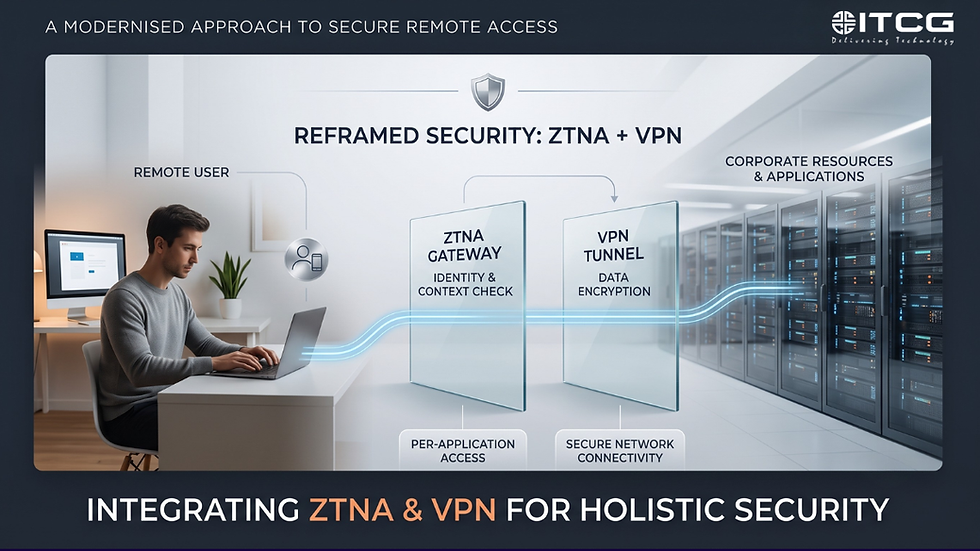
VPNs encrypt traffic between an endpoint and the corporate network, creating a private, secure tunnel. Once users connect, they typically gain broad network access. This model served well when applications were mostly on-premises and bandwidth demands were lower. However, scaling VPN to meet the needs of widespread remote work can stretch resources, lead to higher latency, and expand your attack surface.
The Evolution: What ZTNA Brings
ZTNA limits access to only the specific applications and resources users need. It verifies continuously, checking factors like identity, device health, and user behavior before and during sessions. According to Trend Micro, this granular structure significantly reduces lateral movement risk if an account is compromised. ZTNA also hides applications from the internet, making them much harder for attackers to locate and exploit.
Notably, Zscaler indicates 65% of enterprises plan to replace their VPNs with ZTNA. The primary reason is resilience; ZTNA typically scales more gracefully and enforces policy-based controls across diverse endpoints, whether they are managed or unmanaged devices in use by external partners.
Working in Harmony: VPN and ZTNA
While ZTNA can be a cornerstone of future-proof security, it does not necessarily replace VPN outright. Certain scenarios still call for direct network-level access, like specialized administrative tasks. Many organizations are adopting a hybrid model:
Selective VPN Usage: Reserve VPN for specific internal processes and scenarios requiring broader network connectivity.
ZTNA for Everyday Access: Use ZTNA for web applications, cloud resources, and any remote functionalities that only require minimal app-level access.
Layered Policies: Build a zero-trust architecture on top of existing VPN frameworks to validate users and devices continuously.
This synergy offers the encryption and tunneling benefits of VPN, while heavily restricting the chance of attackers traversing your network.
ITCG Solutions Pvt. Ltd. as Your Partner
Designing a secure remote access strategy requires finesse. Careful planning and ongoing maintenance can ensure a seamless user experience along with top-tier security. ITCG Solutions Pvt. Ltd. offers consulting services to help you implement a plan that balances traditional VPN needs with modern ZTNA frameworks.
Our team can:
Assess your existing VPN environment.
Recommend ZTNA deployments aligned with your business goals.
Provide round-the-clock support so your workforce stays productive.
When woven together thoughtfully, VPN and ZTNA create a layered approach that addresses immediate remote connectivity demands and prepares your organization for the future.
Conclusion
VPN remains a robust tool for tunneling traffic and safeguarding data in transit, but ZTNA raises your defenses through granular app-level controls and continuous verification. Combining these strategies helps organizations mitigate malware threats, prevent lateral attacks, and protect critical assets without overburdening users. If you’re seeking a professional roadmap for secure remote access, ITCG Solutions Pvt. Ltd. can guide you with personalized solutions, ensuring you remain agile, secure, and ready to grow.


Comments